



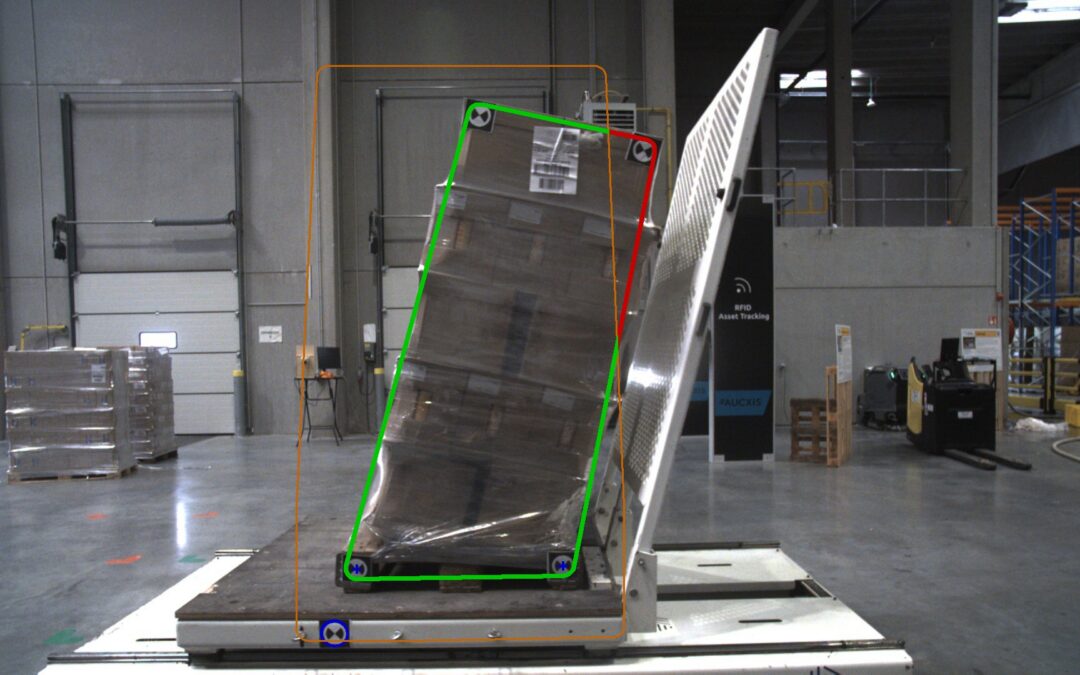
During our acceleration tests to EUMOS 40509 we regularly see the same picture. The stack itself stays more or less square, the boxes barely deform — and yet the entire load slides off the pallet. The connection between the goods and the pallet is gone. Anyone who has to explain that result afterwards usually looks at the cardboard or the stacking pattern. In many cases, though, the cause is far more mundane: the stretch film at the bottom is narrower than the setting on the wrapper suggests.
In the photo above: an acceleration test to EUMOS 40509. The green contour shows the maximum elastic deformation of the load unit; the blue markers at the bottom track the pallet itself.
Shippers and packaging engineers are far less familiar with this phenomenon than with pre-stretch or holding force, even though it strikes exactly where it hurts most. Pallet stability with stretch film does not start at the top, but with the last two wraps at the bottom of the load.
Two failure patterns, one location
The EUMOS 40509 test accelerates and decelerates the load unit horizontally up to 0.5 G, comparable to firm braking. The failure at the base shows up in two variants.
In the first, the film releases the pallet itself. The bands slide up over the top edge of the deck and from that moment on the load simply sits loose on the wood. In the second, the film does stay attached to the pallet, but the bottom webs are slack and crumpled. The load then shifts as a single block and the bottom row of boxes ends up overhanging the deck edge.
Different picture, identical conclusion: the anchorage between load and pallet no longer does anything. That is a different failure mechanism from the stack deformation the EUMOS 40509 method primarily captures, and it deserves a separate finding in a test report.
Stretch film does not only stretch lengthwise
To understand why those bottom bands fall short, you need to know what happens to the film during wrapping.
Polyethylene is essentially incompressible. What you gain in length, you lose in width and in thickness. Pre-stretch the film by 250 per cent and it becomes roughly three and a half times longer — and that gain is paid for with a thinner and a narrower web. This lateral pull-in is called neck-down, or narrowing.
A worked example that matches what we measure in practice: a 500 mm roll of 23 micron film at 250 per cent pre-stretch. On the load you will typically still measure about 400 mm of width and a thickness in the region of 8 micron. Twenty per cent of your web width has therefore disappeared before the film even touches the pallet. With long free spans between the last roller and the load, or on wrappers using a brake system instead of true pre-stretch rollers, that loss rises to thirty or forty per cent.
How much narrowing you get depends mainly on the distance between the pre-stretch rollers: the shorter that stretch gap, the less the film can pull in sideways. Beyond that, the free span to the load, the film construction — multilayer films narrow noticeably less than monolayer material — and the temperature in your hall all play a part.
From 500 to 400 mm: where your overlap disappears
This is where the real problem sits. Wrapping programmes are almost always set up using the nominal roll width. If you calculate with 500 mm and thirty per cent overlap while you effectively have 400, your actual overlap is close to zero. Locally you may even end up with open gaps between wraps.
That explains a good share of the cases where the measured holding force per wrap is perfectly fine, yet the unit still is not stable. It is not the force that falls short — the coverage does not add up.
Why the bottom wraps suffer most
A film band can only transfer shear force to the pallet if it actually spans the joint between the top deck and the bottom row of boxes, with sufficient height on both sides. Not near it: across it.
Suppose your programme provides two bottom wraps that together should cover the top 60 mm of the pallet and the bottom 200 mm of the load. With a quarter of narrowing that leaves 375 mm, and with the usual tolerance on the height setting of the wrapper the band ends up mostly on the wood or mostly on the boxes. Your anchorage has not become weaker — it simply is not there.
An aggravating factor: bottom wraps are usually applied at the highest pre-stretch, sometimes deliberately as a rope. Roping maximises the narrowing and concentrates everything at a single height. If that strand slips up over the rounded deck edge during the acceleration peak, the entire anchorage is gone in one movement.
Consider the nature of the connection as well. As long as the film does not grip under the deck edge or between the blocks, the coupling to the pallet is purely friction-based: polyethylene on smooth, dusty or sometimes damp timber. That friction is low and highly variable.
What a sound wrapping pattern looks like
Let us make it concrete. Take a Euro pallet of 1200 by 800 mm, 1600 mm high, forty boxes in eight layers, wrapped with a 23 micron film at 300 per cent pre-stretch. That film comes off a roll 50 cm high, and every wrap is laid 25 cm — half a web — over the previous one. It is that overlap which interlocks successive layers and creates the cohesion of the wrap. For boxes, 50 per cent overlap is standard; for trays we advise 35 per cent.
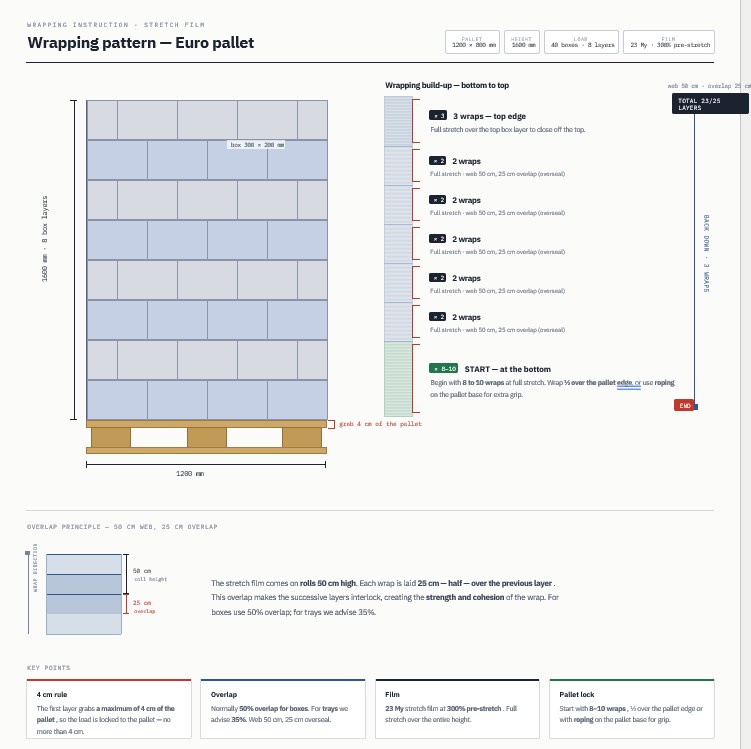
From bottom to top, such a programme then looks like this. At the base come eight to ten wraps at full stretch, with the film gripping over the pallet edge: take exactly 4 cm of the pallet along, no deeper, so the load is genuinely locked to it. If you want extra grip, lay a rope at the pallet base. The carriage then climbs in steps, two wraps at each height, closes the top layer of boxes with three wraps at the upper edge, and lays another three layers on the way back down. Twenty-three to twenty-five wraps in total.
Those 4 cm are not an arbitrary figure, and wrapping deeper is not safer. Below that line the film ends up in the zone where the forklift tines enter the pallet. On the very first handling it is then already cut or torn away, and the anchorage you have just built is gone before the load unit even leaves your warehouse. That must be avoided at all times. Automated warehouses impose the same limit: their handling systems will not tolerate film in that zone.
Now factor the narrowing back in. At 300 per cent pre-stretch, a 500 mm web often retains only 350 to 400 mm in practice. Your 25 cm overlap drops to 10 or 15 cm, and the 4 cm you meant to take along on the pallet is the first thing to disappear as soon as the height setting is off by even a centimetre. The pattern on paper still adds up; the wrap on the floor does not.
And then there is stress relaxation
Stretch film loses a substantial part of its initial tension within the first twenty-four hours, and the higher the pre-stretch, the more pronounced that decay. Heat accelerates it. A holding force measured at the wrapper therefore says little about the condition inside a heated trailer after a night on the road. Testing shortly after wrapping gives an optimistic picture on that point.
What you can measure yourself
You do not need a laboratory to find out whether this applies to you. Three simple observations will take you a long way.
Measure the effective width of a film band on a wrapped unit and compare it with the roll width printed on the box. Then measure how many webs actually span the joint between pallet and load, and over what height. Finally, track film consumption per unit, in grams per pallet. That last figure is the most robust control measure there is, because it is immune to arguments about settings: fewer grams means less material around your load, whatever the display on the wrapper says.
A measured width of 430 mm on a 500 mm roll tells you immediately that pre-stretch is modest at best — and therefore that substantially more film is needed to reach the same holding force.
From observation to evidence
What a test adds is the separation of causes. By placing markers both on the pallet and on the bottom row of boxes, we isolate the failure of the anchorage from the deformation of the stack. Without that reference you attribute a film problem to your cardboard, and spend months optimising the wrong end of the pallet.
CS-TS carries out that EUMOS 40509 test at your own site, with a mobile test laboratory that comes to your warehouse. We do not sell film or wrapping machines ourselves — our finding is the finding, not the opening move for a quotation. If your load unit passes the test at 0.5 G, a transport-safe certificate follows, with which you meet your legal obligations as a shipper.
Not sure whether your bottom wraps do what you expect of them? Get in touch — we are happy to think along with you, without obligation.