



European Cargo Safety Card
EUMOS 40674 Safety Card
For several years now, Belgian law has obliged shippers to pass certain information on to the carrier of their goods. To meet that information transfer obligation, a large group of European technical experts, scientists and companies has been working intensively since 2019 on the standard “EUMOS 40674: European safety cards”.
This European Cargo Safety Card (ECSC) is a recommended format for sending instructions, recommendations, agreements and any other information needed to secure the load correctly.
The European Cargo Safety Card allows companies to provide the mandatory transfer of information on cargo and cargo securing to the carrier and to other parties involved, such as enforcement authorities or the consignee. The file can be linked to the eCMR or to other EDI files for data processing. Transferring the safety card information gives everyone involved insight into the methods and means required to carry the load safely, by road, by rail as well as by sea.
The European Cargo Safety Card
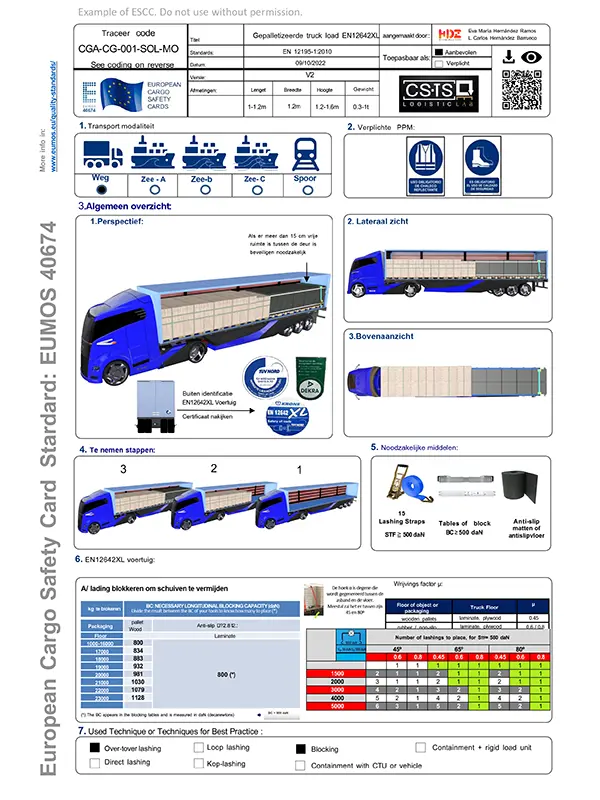
Request a European Cargo Safety Card
With these EUROPEAN CARGO SAFETY CARDS you can easily meet every legal obligation on the transfer of information about your load.
Twofold purpose of the safety card
Technical
- Responsible publisher: name, company and signature.
- Date of issue.
- Traceability code (AAA-BB-OOO-CCC-DD)
- The transport mode the ECSC applies to.
- Drawings or photographs showing two or more views of the load as stowed.
- The required and recommended cargo securing equipment to be used, with the minimum required value for each.
- The stowage method used: blocking; locking; direct lashing or top-over lashing (a combination is allowed).
- Dimensions and weight of the freight (length x width x height) + position of the centre of gravity of each load unit if it is not central.
- Cargo securing calculation
- Required personal protective equipment.
- (optional) Minimum requirements for the vehicle
Legal
- Applicable regulations
- Any agreements departing from the transport conditions
- Technical and legal recommendations during transport.
- Special instructions for the transport (e.g. the obligation to check the lashing tension of the belts during transport, and how often).
- Claim period, in accordance with CMR
- Data protection statement.
- Chain of responsibility, reflecting every step of loading, stowing and unloading. Transport under the responsibility of each of the parties involved.
- Signature of the head or the representative of the company.
- Signature of the person responsible for calculating the cargo safety card, identified by name and registration number where applicable.
- Details of the lawyer responsible for the legal drafting, identified by name and registration number where applicable.
- Signature of the carrier, date, registration plate of the trailer and acceptance of the loading and stowage.
Frequently asked questions about the European Cargo Safety Card
Is the European Cargo Safety Card used to establish agreements between the parties?
Yes. They are used to pass on instructions and/or recommendations, but also to define agreements between the parties in a very specific way: who has to secure the load, who indicates the weight distribution, who supplies the stowage equipment, and so on. European Cargo Safety Cards (ECSC) can also be included in contracts, or act as a private agreement signed by the various parties.
Does an ECSC have to be issued every time a loading takes place?
No. A European Cargo Safety Card (ECSC) is developed for a cargo group, and a single ECSC can be valid for thousands of loadings because it covers a range of cases. Each company and the transport company concerned only have to sign it once. It is then registered with EUMOS and can be verified en route (by the enforcement authorities). It proves that this agreement exists and how a load has to be stowed correctly.
Can the European Cargo Safety Card be passed on to different carriers (main carrier, subcontracted carrier)?
Yes. There are document management programmes and smart guides that let you send the files to a large number of carriers at once, for signature and for information.
Is the ECSC only an agreement, or also a certificate?
ECSCs are signed by a qualified expert. The European Cargo Safety Card can be used as a certificate showing that the calculations and techniques comply with the applicable regulations.
Can video or other interactive features be added to ECSCs?
Yes. ECSCs can contain videos, podcasts, links and other features through the QR code.
Which departments use ECSCs in companies?
Human Resources can use the European Cargo Safety Card to train staff. The prevention department can add it to its internal procedures. Quality can include it in its working procedures. Logistics uses it to follow up cargo securing operations, to train its staff and to pass recommendations or instructions on to transport companies. Administration can use it to negotiate a better price with the insurer.
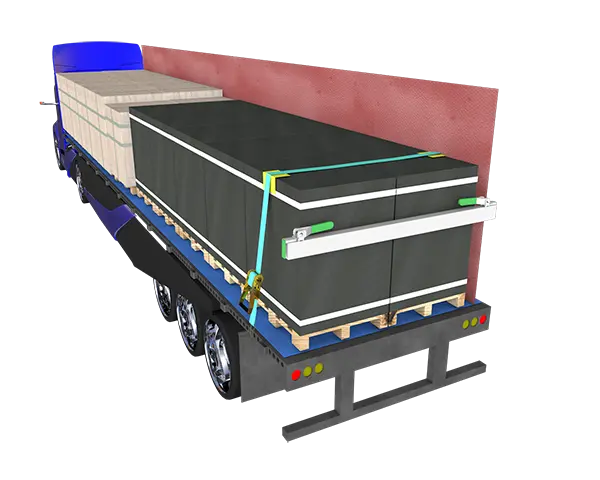
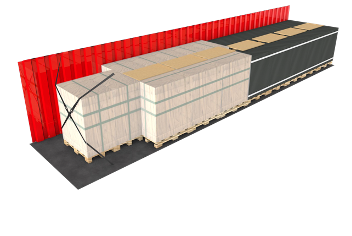
Have your pallet stability tested
To carry your load safely, it has to be packed correctly and secured to a pallet. Want to be sure about your packaging method? Have your load tested.
- We come to you with our test bench to test your load units!
- You save time and money because there is no pre-carriage or onward carriage to arrange.
- Your staff do not have to be present at the test. They can simply carry on working.
- Lower packaging costs
- More safety in your warehouse
- More safety during your transport (both internally and by road, rail or sea transport)
- EUMOS 40509 certification
- No insurance dispute in the event of damage
- You can present the required documents at a roadside police check.
Pallet stability testing on site
- No transport costs
- Test results available immediately
- Immediate corrections or adjustments to your load units are possible
- Issue of a “transport safe certificate”
- No more police hold-ups at checks on the EUMOS 40509 standard (DIN 55415)
- …